Deregulation, Neoliberalism, and the Expanding Wealth Gap
A Critical Analysis and Working Report - Aubrey Waddle
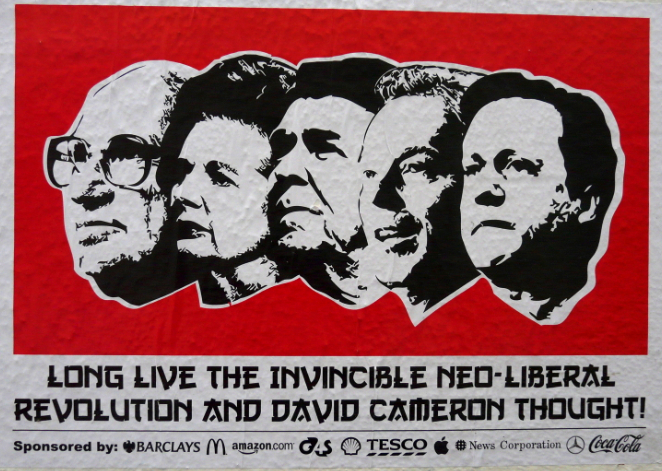
Deregulation Isn’t “Freedom.” It’s a Transfer of Wealth to the Already Wealthy.
For decades, Americans have been sold a simple story: cut regulations, unleash markets, and everyone prospers. Politicians from Ronald Reagan to Bill Clinton to today’s bipartisan chorus of neoliberal cheerleaders have repeated this mantra so often that it’s taken on the feel of common sense. After all, if the stock market rises, we’re told, the country must be doing well.
But this story falls apart the moment you examine who actually benefits from deregulation— and who pays the price.
If deregulation merely redistributed wealth upward, that would be bad enough. But it also creates real harm for working-class people, who bear the consequences of weakened oversight.
Consider the pharmaceutical industry. Regulatory gaps and aggressive lobbying helped fuel the opioid crisis that devastated communities across the country. Companies cut corners, flooded markets with addictive drugs, and reaped billions while families were torn apart.
Or look at fossil fuel companies. When environmental safeguards loosen, these industries get cheaper waste management and higher profit margins—but at the cost of air quality, water safety, and the health of working families living near extraction sites. Additionally, studies show blue-collar workers face an increasing headwind as the effects of anthropogenic climate change worsen. "U.S. construction workers are at a high risk of heat-related death, and this risk has increased with climate change over time."
And then there’s healthcare. Instead of following other developed nations toward universal public healthcare, the U.S. embraced a public–private partnership model under the Affordable Care Act—one designed to preserve insurance company profits rather than guarantee care. Neoliberalism protects markets first and people second, if at all.
These aren’t abstract policy debates. They are real examples of how deregulation—sold as efficiency—becomes exploitation.
Regulations Aren’t Bureaucratic “Red Tape.” They’re Protections Written in Blood.
There’s a reason labor laws, environmental standards, consumer protections, and workplace safety rules exist. Every one of them is a response to harm. They are written because someone was injured, poisoned, defrauded, or killed.
Remove them, and the same incentives that caused the harm in the first place return stronger than ever.
Under neoliberal deregulation, cutting costs becomes synonymous with cutting corners: workers lose safety protections, communities deal with more pollution, consumers are exposed to risk, unions weaken, wages stagnate, and bargaining power evaporates.
Meanwhile, profit margins widen—and the owners of those profits overwhelmingly belong to the top 10 percent.
This is not a coincidence. It is the design.
Neoliberal Deregulation Widens the Gap on Both Ends
Deregulation hurts working people directly by stripping away protections. But it also harms them indirectly by enriching the capital-owning elite at their expense. Higher corporate profits don’t show up as higher wages. They show up as stock buybacks, rising dividends, executive compensation packages, and inflated asset values.
These are mechanisms that overwhelmingly reward those who already own capital, not the people whose labor produces the wealth in the first place. Meanwhile, the working class gets a harsher environment, lower wages, more insecurity, and fewer avenues to fight back. The neoliberal promise of shared prosperity is a mirage— One made possible only by ignoring who actually owns the nation’s wealth.
Neoliberalism didn’t fail to deliver broad prosperity. It delivered exactly what it was structured to deliver: upward redistribution, as we will explore below. As long as political leaders on both sides of the aisle cling to the fantasy that freeing corporations from oversight somehow benefits ordinary Americans, the wealth gap will continue to widen. Deregulation doesn’t create freedom for society; it creates freedom for corporations to extract more wealth from society.
And until we recognize that, the richest Americans will keep getting richer—not because they’re working harder or creating more value, but because the rules have been rewritten to ensure that the gains flow overwhelmingly upward. The working class isn’t losing because of personal shortcomings or bad luck. It’s losing because the system is designed for them to lose.
How Housing Fuels the Modern Wealth Gap
Today, the bottom half of Americans face disproportionately severe pressures from housing costs, healthcare expenses, student debt, and job insecurity—pressures that barely register for the ultra-wealthy. Housing has become one of the central engines of modern wealth inequality, transforming shelter from a basic need into a primary vehicle for asset accumulation by those who already own.
In 2025, the median first-time homebuyer was 40 years old. The median homebuyer overall was 59. In 2025, more homes were purchased by people over 70 than by those under 35. All the while, the average age of new hires in 2025 was 42 years old.
These are not cultural failures or personal shortcomings; they are symptoms of an economy that systematically channels wealth upward while leaving basic needs increasingly unaffordable for the majority. As older and wealthier buyers consolidate property, rising prices and higher interest rates lock younger and working-class households out of ownership entirely. This dynamic turns rent into a permanent transfer of income upward, while home equity—one of the main sources of middle-class wealth—remains concentrated at the top. The result is a self-reinforcing cycle where those with property grow richer simply by holding it, while those without are priced out of building any comparable wealth at all.
The Neoliberal “Zero-Sum” Straw Man—and Why It Misses the Point
Now, let's explore how neoliberalism's defense of the status quo also widens the wealth gap and why that's bad, actually. Let’s start with a number that should end the debate entirely: as of Q2 of 2025, the wealthiest 1 percent of Americans own 49.9 percent of all corporate equities. The next 9 percent own 37.3 percent. The following 40 percent own a measly 11.7 percent. Half the country owns none at all, effectively. This is according to Federal Reserve Bank of St. Louis data.
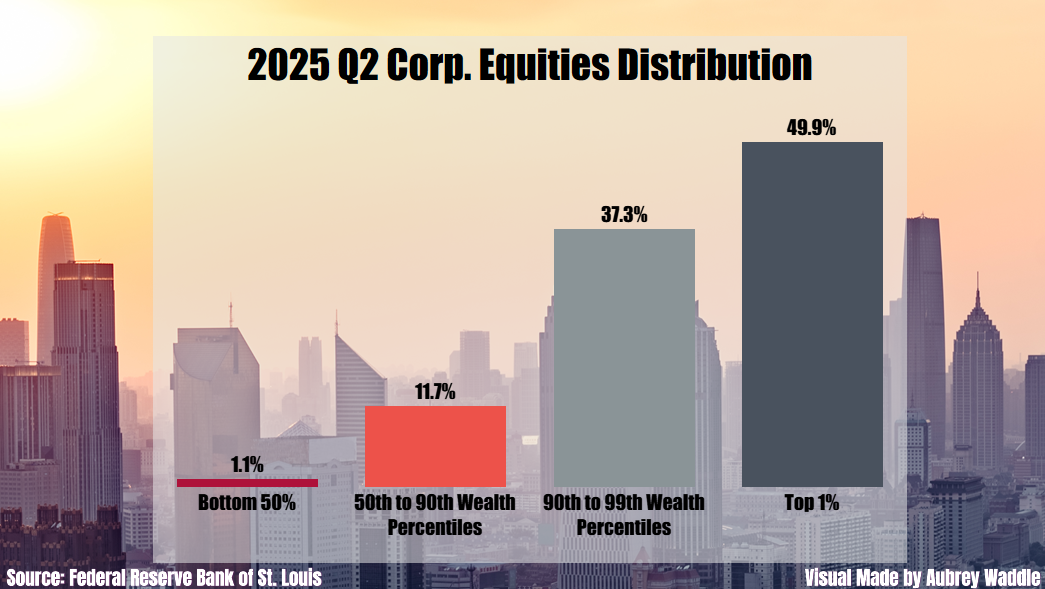
Defenders of neoliberalism often retreat to a familiar accusation whenever wealth inequality is raised: that critics are viewing the economy as a zero-sum game. According to this framing, any concern about the concentration of wealth must imply a belief that gains at the top necessarily require losses at the bottom—and since living standards have broadly improved over the last century, the critique is dismissed as ignorant or unserious.
But this is a fundamental misrepresentation of the argument.
Pointing out that nearly all corporate equity is owned by the top 10 percent, or that wealth concentration today rivals—and in some measures exceeds—that of the Gilded Age, is not a claim that society has failed to produce material progress. The person living in their car in the 1930s was certainly worse off than the person living in their car today, as free market innovations made heating and cooling standard in automobiles between then and now. It is a claim about distribution, power, and exposure to risk. Yes, average living standards have improved in many forms. Indoor plumbing, consumer electronics, and medical advances are real. But those gains coexist with—and are increasingly overshadowed by—a structural imbalance in who bears the costs of modern life and who is insulated from them. Given the abundant wealth that exists today, why is anyone still having to resort to living in their car?
Crucially, addressing this imbalance does not require sacrificing innovation, technology, or quality of life. Even dramatic reductions in the wealth of the ultra-rich would leave them extraordinarily wealthy, fully capable of driving consumption and investment. The difference is that redistributing a portion of that excess could materially reduce suffering at the bottom—expanding access to housing, healthcare, education, and childcare without diminishing society’s productive capacity.
Critics of neoliberalism are not arguing that progress must stop so equality can advance. They are arguing that progress should be shared, and that the existing distribution of wealth reveals where the resources to solve persistent social problems already exist.
The insistence that any further critique amounts to envy or endless dissatisfaction misunderstands the nature of systemic improvement. A society can achieve real gains and still recognize its remaining failures. Like public health officials refining a successful vaccine rollout, they don't then quite stop working because they've achived 90% immunity, they continue to work toward 100%. The pursuit of better outcomes does not negate past success; it builds on it.
To frame this critique as zero-sum thinking is not an honest engagement. It is a rhetorical maneuver designed to shut down discussion about power, ownership, and whose lives are treated as expendable. And as long as that maneuver succeeds, the wealth gap will continue to widen—not by accident, but by design.
References
Dataset used can be downloaded HERE,
Data was obtained from the Federal Reserve Bank of St. Louis website.