Blaming Immigrants Is a Fascist Misdirection
Commentary - Aubrey Waddle
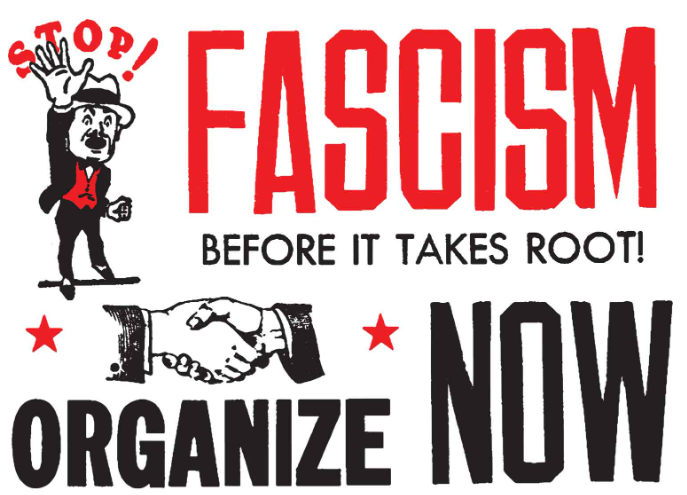
Fundamentally, it is wrong—both morally and analytically—to blame immigrants, whether documented or undocumented, for the material problems facing people in the United States today. This narrative is not merely incorrect; it is a deliberate misdirection. History provides some of the clearest and most well-documented examples of how this misdirection functions, particularly in the fascist regimes of the 1930s and 1940s.
Fascism does not emerge in a vacuum. In Germany, Adolf Hitler’s rise was built on a mythology of national identity, racial purity, and social “degeneracy.” Fascist ideology insists that society is decaying from within and that this decay must be violently stamped out. This cultural logic echoes later phenomena such as the culture of conformity of 1950s America, itself deeply influenced by earlier fascist and otherwise anti-communist social currents.
But fascism is not only cultural—it is economic. It reliably aligns itself with capitalist interests through privatization, deregulation, corruption, and the concentration of wealth. The state bureaucracy under fascism overwhelmingly serves a capital-owning elite, often enriching itself in the process. Hitler understood this clearly.
Right-Wing Populism Requires an Enemy
To transfer wealth upward—from workers to a ruling elite—right-wing populism requires an enemy. All populism depends on an “us versus them,” but right-wing populism specifically targets a marginalized out-group that is no better off, and often worse off, than the broader working class itself.
In 1930s and 1940s Germany, that out-group was Jews—alongside Romani people, LGBTQ people, Muslims, Black people, and others excluded from the mythical “Aryan” race. Jewish people were simultaneously portrayed as all-powerful puppet masters secretly controlling society and as degenerate, impoverished subhumans living in ghettos. This contradiction was not a flaw; it was the point. It allowed ordinary Germans to believe that their suffering was caused not by industrialists or landlords, but by a fabricated internal enemy.
Hitler explicitly framed politics in these terms. With this framing, deportation appeared as a solution. Early Nazi policy focused on expulsion—plans to deport Jews to Madagascar, to British Mandate Palestine, or anywhere else willing to take them. When deportation became politically and logistically impossible, the regime escalated to genocide. The “Final Solution” was not a break from earlier policy, but its grim continuation.
Deportation, ICE, and the American Pattern
This same pattern is visible today in the United States under Donald Trump. The central promise is deportation. The mechanism is ICE—a federal force operating with extraordinary autonomy, often outside meaningful coordination with local authorities. Police chiefs and local officials have repeatedly stated that they are left uninformed about ICE raids, unable to advise their communities, and powerless to intervene.
ICE increasingly functions as a modern analogue to the Gestapo and, perhaps more specifically, the Einsatzgruppen—paramilitary forces empowered to act with impunity. This reality was underscored by the killing of Renee Good, a woman shot and killed by ICE despite posing no threat. This is not an aberration; it is the logical outcome of granting a security force unchecked power under a fascist framework.
Trump’s rhetoric and policy mirror historical fascist regimes precisely. His goal is to enrich himself and his donor class—the capital-owning elite. All the while, his base is skeptical of traditional coastal elites. Being aware of this, Trump attempts to resolve this contradiction by redirecting anger downward using familiar strategies of right-wing populists. Immigrants become the scapegoat: they are blamed for wage suppression, unemployment, crime, and welfare dependency—while simultaneously being described as lazy and parasitic.
This contradiction is identical to fascist demonization historically. Immigrants are portrayed as both hyper-productive job stealers and criminal freeloaders. This narrative is not accidental; it is structurally necessary.
Who Actually Has Their Hand in Your Pocket?
This misdirection prevents people from confronting the real sources of economic pressure: monopolization, oligarchy, and corporate power. The military-industrial complex, the fossil fuel and energy industries, and the tech oligarchs—Peter Thiel, Mark Zuckerberg, Elon Musk, Jeff Bezos, Bill Gates, and Alex Karp of Palantir—are all aligned, implicitly or explicitly, with Trump’s project. Their profits depend on keeping workers divided, distracted, and politically disorganized.
Recent economic data makes this reality unmistakable. In 2025, job growth in the United States was stagnant. Wages were stagnant. Yet productivity rose by double-digit percentages. This is not a mystery. It is surplus value extraction. It is wealth being siphoned upward while workers are told to blame migrants instead of the incentives of the C-suite executives for their economic immobilization.
This is why otherwise “liberal” business leaders are either silent or supportive of Trump’s authoritarian turn. Fascism preserves capitalism by deflecting class anger. Warehouse workers, machinists, Uber drivers, and service workers are kept busy chasing ghosts instead of analyzing why productivity gains never reach their paychecks.
Resistance Under Economic Constraint
Fascism also tightens the material constraints that make resistance difficult. As working hours increase just to afford rent and basic survival, people have less time and energy to protest or engage in direct action. The decline in mass participation compared to moments like Occupy Wall Street or the George Floyd protests is not accidental—it is structural.
Communists, anarchists, and trade unionists historically form the backbone of anti-fascist resistance. But when missing a shift means eviction or hunger, organizing becomes materially dangerous. This is another clamp imposed by fascist capitalism: starve resistance by exhausting the working class.
Liberal Failure and Third Way Complicity
Compounding the problem is the failure of the Democratic Party, social democrats, and Third Way neoliberals to meet the moment. Rather than unequivocally opposing ICE, many Democratic leaders merely argue for “better training”—the moral equivalent of demanding a more professional Einsatzgruppen. This is not opposition; it is managerial complicity.
This failure mirrors historical precedents. Liberal institutions consistently underestimate fascism, believing it can be moderated or bureaucratically restrained. It cannot.
The only path to redemption for the current Democratic Party would be total confrontation. When next in power, the first priority must be comprehensive prosecution of this administration—from ICE agents on the ground to figures like Stephen Miller, Pete Hegseth, JD Vance, and Donald Trump himself. Anything short of full accountability—anything less than sustained legal and political reckoning—will represent yet another institutionalist failure to confront fascism.
Conclusion: The Enemy Is Systemic
Immigrants are not the enemy. They are neighbors, coworkers, and fellow members of the working class. They have not stolen from us. The people with their hands in our pockets are landlords, executives, monopolists, and politicians funded by corporate power.
Fascism depends on preventing people from realizing this. It replaces systemic analysis with manufactured hatred. And unless that misdirection is rejected outright, history shows us exactly where it leads.